
MCP vs A2A: The Complete Guide to AI Agent Protocols in 2026
By DevRel As Service • Updated February 2026 • Originally published March 2025 • 20 min read
01. Introduction
The AI agent ecosystem has undergone a seismic shift since we first published this guide in early 2025. What were once nascent protocols have matured into foundational infrastructure powering thousands of applications worldwide. The Model Context Protocol (MCP) and the Agent-to-Agent (A2A) Protocol now stand as the two defining standards shaping how AI systems access tools, consume data, and collaborate with each other.
In 2025, the industry settled a critical question: MCP and A2A are not competitors — they are complementary layers of the same stack. MCP handles the vertical integration between AI models and their tools and data sources. A2A handles the horizontal collaboration between independent AI agents. Together, they form the backbone of modern agentic architectures.
This updated guide reflects the current state of both protocols as of February 2026, covering the latest specification changes, the emergence of MCP Apps for interactive UIs, the evolution from SSE to Streamable HTTP transport, A2A's deep integration with Google's Agent Development Kit, and the rapidly growing ecosystem around both standards.
“MCP is how AI models reach out to the world. A2A is how AI agents reach out to each other. Together, they enable the agentic future.”
The Protocol Landscape in 2026

Figure 1: The two-protocol architecture powering modern AI agent systems
After reading this guide, you will understand:
- The current MCP specification (v2025-11-25) and its key features including Apps, Streamable HTTP, and OAuth
- How MCP transports evolved from stdio to SSE to Streamable HTTP
- The MCP Apps extension for interactive user interfaces
- A2A's integration with Google's Agent Development Kit (ADK)
- How MCP and A2A complement each other in production architectures
- The current ecosystem adoption across major platforms
- What to expect from both protocols in 2026 and beyond
02. What is MCP?
The Model Context Protocol (MCP) is an open standard created by Anthropic that provides a universal way for AI applications to connect to external data sources, tools, and services. Since its introduction, MCP has become the de facto protocol for tool integration across the AI industry, with adoption spanning from Anthropic's own Claude to OpenAI's ChatGPT, Microsoft's VS Code, and dozens of other platforms.
At its core, MCP uses a client-server architecture. An AI application (the Host) contains an MCP Client that communicates with MCP Servers. Each server exposes a set of capabilities — Tools for executing actions, Resources for providing data, and Prompts for templated interactions — through a standardized JSON-RPC protocol.
MCP Core Components
| Component | Description |
|---|---|
| MCP Host | An application (Claude Desktop, ChatGPT, VS Code, Cursor) that uses MCP to access external capabilities. |
| MCP Client | The protocol handler within a Host that manages connections to one or more MCP Servers. |
| MCP Server | A program exposing Tools, Resources, and Prompts through the MCP standard. Over 10,000 servers exist in public registries. |
| Tools | Executable functions the AI model can invoke (e.g., query a database, send an email, create a file). |
| Resources | Data the server provides for context (e.g., file contents, database records, API responses). |
| Prompts | Templated interaction patterns the server offers to guide AI behavior for specific tasks. |
The Latest MCP Specification: v2025-11-25
The November 2025 specification release brought significant enhancements to MCP, solidifying its position as the leading tool integration protocol:
- OpenID Connect Discovery: Standardized authentication server discovery, making it easier for clients to find and authenticate with remote MCP servers using established identity providers.
- Icons for Primitives: Tools, Resources, Resource Templates, and Prompts can now include icons, improving discoverability and UX in host applications.
- Incremental Scope Consent: Via WWW-Authenticate headers, servers can request additional permissions incrementally rather than upfront, following the principle of least privilege.
- Tool Calling in Sampling: The sampling capability now supports tools and toolChoice parameters, enabling more sophisticated model interactions within the protocol itself.
- OAuth Client ID Metadata Documents: Simplified client registration flows for OAuth-based authentication.
- Experimental Tasks: Durable requests with polling and deferred result retrieval, enabling long-running operations that survive connection interruptions.
- URL Mode Elicitation: Servers can request users to provide URLs through standardized UI interactions.
- SDK Tiering System: Clear requirements and expectations for official and community SDKs.
- Formalized Governance: Working Groups and Interest Groups structure for protocol evolution.
MCP Architecture Overview
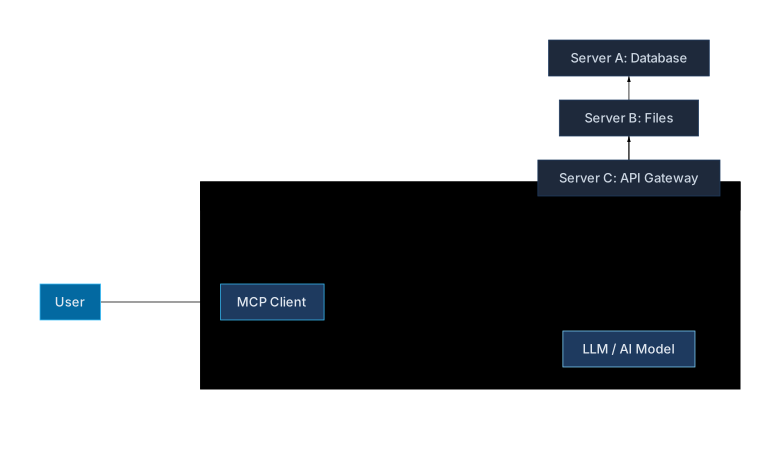
Figure 2: MCP architecture with multiple servers connected via different transports
Official MCP SDKs
The MCP ecosystem now offers official SDKs across six programming languages, organized under a tiering system that sets clear expectations for feature completeness and maintenance:
- TypeScript — The reference implementation, most feature-complete
- Python — Full-featured with async support
- Java — Enterprise-grade implementation
- Kotlin — JVM and Android support
- C# — .NET ecosystem integration
- Swift — Apple platform support
03. MCP Apps and Interactive UIs
Perhaps the most transformative development in the MCP ecosystem during 2025 was the introduction of MCP Apps — an official extension (SEP-1865) that enables MCP servers to provide interactive user interfaces alongside their tools and data.
Before MCP Apps, AI assistants could only return text, code, or structured data. With MCP Apps, servers can now deliver rich, interactive HTML-based UIs that render directly within the host application. This means a Kubernetes management server can show a live dashboard, a database server can present an interactive query builder, or an analytics server can display interactive charts — all within the AI assistant's interface.
How MCP Apps Work
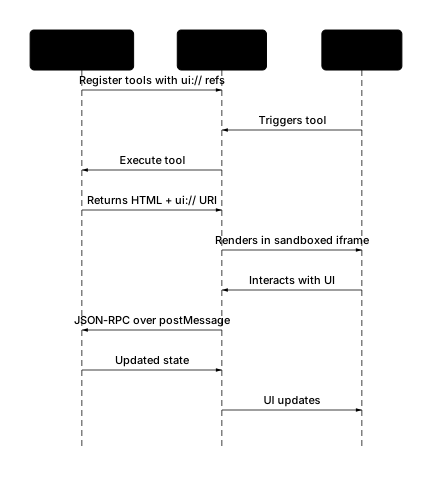
Figure 3: MCP Apps architecture showing UI rendering and communication flow
Key Design Decisions
- UI Resources via ui:// URI Scheme: Interactive UIs are declared as resources using the ui:// scheme, referenced in tool metadata so hosts know which tools can render visual interfaces.
- Sandboxed Iframe Rendering: All HTML content renders in sandboxed iframes, providing strong security isolation between the MCP server's UI and the host application.
- JSON-RPC over postMessage: Communication between the iframe and the host uses the standard MCP JSON-RPC protocol tunneled through the browser's postMessage API.
- Backward Compatible: Existing MCP implementations continue to work unchanged. Apps are an additive extension.
Origins and Adoption
MCP Apps grew out of the MCP-UI project created by Ido Salomon and Liad Yosef, combined with ideas from OpenAI's Apps SDK. The official extension was co-authored by MCP Core Maintainers at both OpenAI and Anthropic alongside the MCP-UI creators. It has been adopted by Claude, ChatGPT, Goose, and VS Code, with companies like Postman, Shopify, Hugging Face, and ElevenLabs building MCP servers that leverage interactive UIs.
04. MCP Transport Evolution
The way MCP clients communicate with servers has undergone a significant evolution, reflecting the protocol's journey from a local development tool to a production-grade remote infrastructure standard.
The Three Generations of MCP Transport
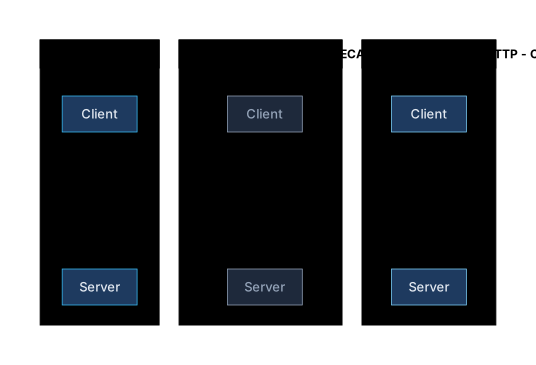
Figure 4: Evolution of MCP transport mechanisms
Why Streamable HTTP Won
The original HTTP+SSE transport required two separate endpoints — one for client-to-server requests (HTTP POST) and another for server-to-client events (SSE). This created challenges for load balancers, CDNs, and stateless server architectures common in cloud deployments.
Streamable HTTP consolidates everything into a single endpoint. Clients send requests via HTTP POST and receive responses either as immediate JSON responses or as SSE streams when the server needs to send multiple messages. This design enables:
- Stateless Servers: No need to maintain persistent connections, enabling horizontal scaling and serverless deployments.
- CDN and Proxy Compatibility: Standard HTTP semantics work naturally with existing infrastructure.
- Graceful Degradation: Servers can disconnect SSE streams at any time, and clients can reconnect and poll for updates.
- Simpler Implementation: One endpoint to implement, configure, and secure instead of two.
Authentication: OAuth 2.1 and OIDC
Remote MCP servers authenticate using OAuth 2.1, with the latest spec adding OpenID Connect Discovery for automatic auth server identification. The incremental scope consent mechanism (via WWW-Authenticate) allows servers to request only the permissions they need, when they need them, rather than demanding broad access upfront.
05. What is A2A?
The Agent-to-Agent (A2A) Protocol, created by Google and now an open standard, enables independent AI agents to discover each other, communicate, and collaborate on tasks. While MCP defines how a single agent accesses its tools and data, A2A defines how multiple agents work together as a team.
Since its announcement in April 2025, A2A has matured into a production-ready protocol with an official website at a2a-protocol.org, deep integration with Google's Agent Development Kit (ADK), and growing adoption across the enterprise AI landscape.
“A2A enables a world where specialized AI agents from different vendors can collaborate seamlessly, combining their unique strengths to solve problems no single agent could tackle alone.”
A2A Core Concepts
| Concept | Description |
|---|---|
| Agent Cards | JSON metadata documents describing an agent's capabilities, authentication requirements, and supported interaction patterns. Published at a well-known URL for discovery. |
| Tasks | Units of work with a defined lifecycle: submitted, working, input-required, completed, or failed. Tasks are the primary abstraction for inter-agent collaboration. |
| Messages | Communication units exchanged between agents during task execution. Each message contains one or more Parts. |
| Parts | Content within messages, supporting text, file attachments, and structured data payloads. |
| Streaming | Real-time updates via Server-Sent Events (SSE) for monitoring task progress and receiving incremental results. |
| Push Notifications | Asynchronous updates for long-running tasks, allowing agents to notify each other without maintaining persistent connections. |
A2A Interaction Flow
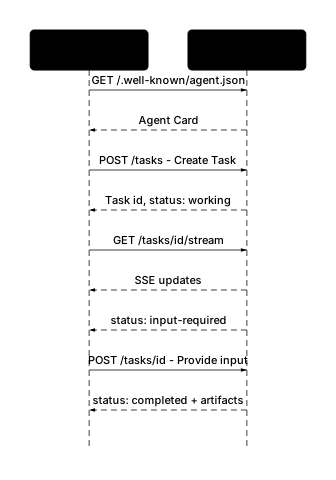
Figure 5: Complete A2A task lifecycle from discovery to completion
A2A Design Principles
- Embrace Agentic Capabilities: Agents collaborate in natural, unstructured ways without requiring shared memory, tools, or internal context.
- Build on Existing Standards: Uses HTTP, SSE, and JSON-RPC — familiar technologies that integrate easily with existing infrastructure.
- Secure by Default: Built-in support for authentication, authorization, and Zero Trust architecture patterns.
- Long-Running Task Support: Tasks can run for hours or days with streaming progress updates and push notifications.
- Modality Agnostic: Supports text, files, structured data, and can be extended to audio and video streaming.
06. A2A with Google ADK
Google's Agent Development Kit (ADK) provides the most mature implementation of A2A, offering first-class support for both exposing agents as A2A servers and consuming remote A2A agents as collaborators. ADK supports A2A in both Python and Go (experimental), with comprehensive quickstart guides and production deployment patterns.
ADK + A2A Architecture
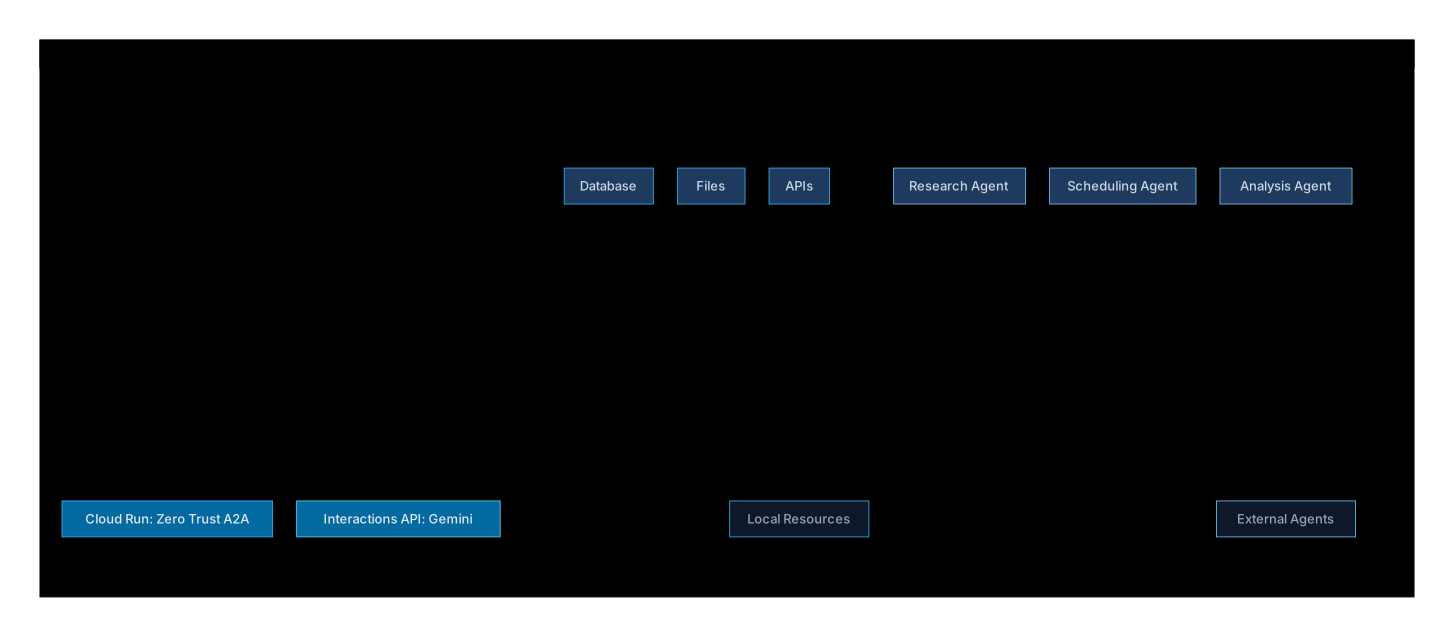
Figure 6: Google ADK supporting both MCP and A2A simultaneously
Key ADK Integration Features
- Dual Protocol Support: A single ADK agent can use MCP tools for data access and A2A for delegating to remote agents, within the same codebase.
- Exposing A2A Agents: ADK provides built-in support for publishing Agent Cards, handling task lifecycle, and streaming results to A2A clients.
- Consuming A2A Agents: ADK agents can discover and invoke remote A2A agents as if they were local tools, with the framework handling protocol details.
- Zero Trust Deployment: Official patterns for deploying A2A agents on Google Cloud Run with per-request authentication and authorization.
- Interactions API: Connect A2A systems to Gemini Deep Research Agent for complex research tasks that require extended analysis.
Example: ADK Agent with Both Protocols
# Conceptual ADK agent using both MCP and A2A

from google.adk import Agent
from google.adk.tools import MCPTool
from google.adk.a2a import RemoteAgent

agent = Agent(
    name="project-manager",
    description="Manages project tasks and coordination",

    # MCP tools for direct data access
    tools=[
        MCPTool(server="database-server"),
        MCPTool(server="calendar-server"),
    ],

    # A2A remote agents for delegation
    remote_agents=[
        RemoteAgent(url="https://research.example.com"),
        RemoteAgent(url="https://analytics.example.com"),
    ],
)

# The agent can now:
# - Query databases via MCP
# - Check calendars via MCP
# - Delegate research to a specialized agent via A2A
# - Request analytics from another agent via A2A
07. MCP vs A2A: Detailed Comparison
Understanding the differences and synergies between MCP and A2A is essential for architects designing modern AI systems. The following comparison reflects the current state of both protocols as of early 2026.
| Dimension | MCP (Model Context Protocol) | A2A (Agent-to-Agent Protocol) |
|---|---|---|
| Primary Purpose | Standardize how AI models access tools, data, and services | Enable independent AI agents to discover, communicate, and collaborate |
| Created By | Anthropic (open standard) | Google (open standard) |
| Architecture | Client-Server (Host connects to Servers) | Peer-to-Peer (Client Agent delegates to Remote Agents) |
| Integration Direction | Vertical: AI model to tools/data | Horizontal: Agent to agent |
| Latest Spec | v2025-11-25 | v1.0 (stable) |
| Transport | stdio (local), Streamable HTTP (remote) | HTTP + SSE, Push Notifications |
| Authentication | OAuth 2.1, OIDC Discovery, incremental consent | Pluggable auth, Zero Trust patterns |
| Key Abstractions | Tools, Resources, Prompts, Sampling | Agent Cards, Tasks, Messages, Parts |
| Interactive UIs | MCP Apps extension (ui:// scheme, sandboxed iframes) | UX negotiation via content type Parts |
| Long-Running Tasks | Experimental Tasks (polling + deferred results) | First-class support (task lifecycle with streaming) |
| Discovery | Server registries, configuration files | Agent Cards at /.well-known/agent.json |
| Official SDKs | TypeScript, Python, Java, Kotlin, C#, Swift | Python (ADK), Go (ADK, experimental) |
| Ecosystem Size | 10,000+ servers in registries | Growing via ADK adoption |
| Major Adopters | Claude, ChatGPT, VS Code, Cursor, Windsurf, Goose | Google ADK, enterprise deployments, Gemini ecosystem |
| Governance | Working Groups + Interest Groups | Open standard via a2a-protocol.org |
08. How MCP and A2A Work Together
The most powerful AI architectures in production today use both protocols simultaneously. MCP handles the “last mile” connection between an agent and its tools and data. A2A handles the coordination between multiple specialized agents working toward a shared goal.
The Complementary Architecture
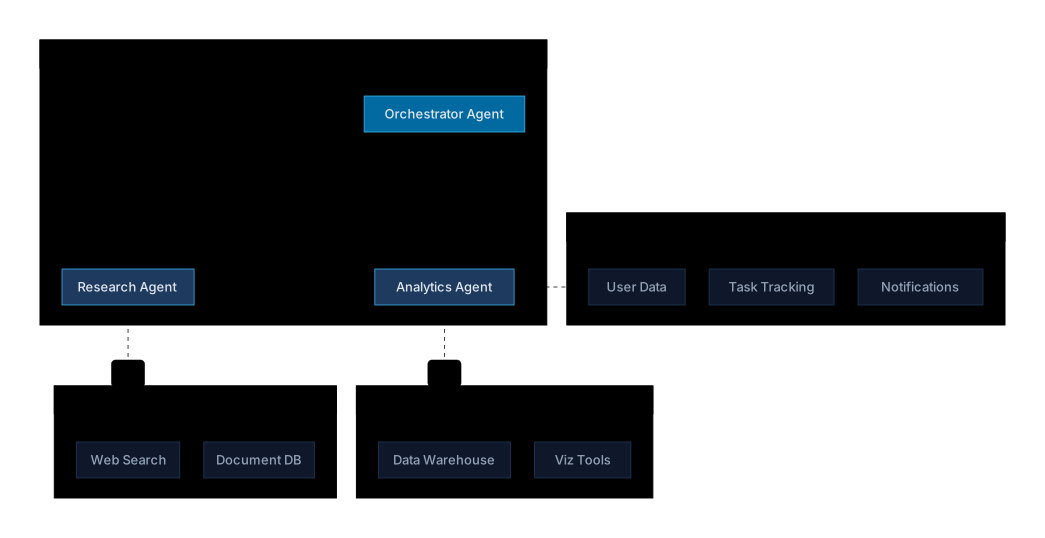
Figure 7: Dual-protocol architecture with MCP for tool access and A2A for agent collaboration
Real-World Example: Enterprise Support System
Consider an enterprise customer support system that combines both protocols:
- Customer-Facing Agent receives a complex support request. It uses MCP to access the CRM database, order history, and knowledge base.
- The issue requires specialized analysis. The agent uses A2A to delegate to a Technical Diagnostics Agent.
- The Diagnostics Agent uses MCP to access system logs, monitoring dashboards, and configuration databases.
- The Diagnostics Agent identifies a billing discrepancy and uses A2A to loop in a Billing Agent.
- The Billing Agent uses MCP to access the payment system and applies a correction.
- Results flow back through A2A to the original agent, which presents the resolution to the customer.
When to Use Each Protocol
- Use MCP when: Your AI application needs to access databases, files, APIs, or external services. You want a standard way to expose your system's capabilities to AI models. You need interactive UIs via MCP Apps.
- Use A2A when: You have multiple specialized agents that need to collaborate. You want agents from different vendors or teams to work together. You need to delegate complex tasks across organizational boundaries.
- Use both when: You are building enterprise-grade agentic systems where individual agents need tool access (MCP) and must coordinate with other agents (A2A).
09. The Current Ecosystem
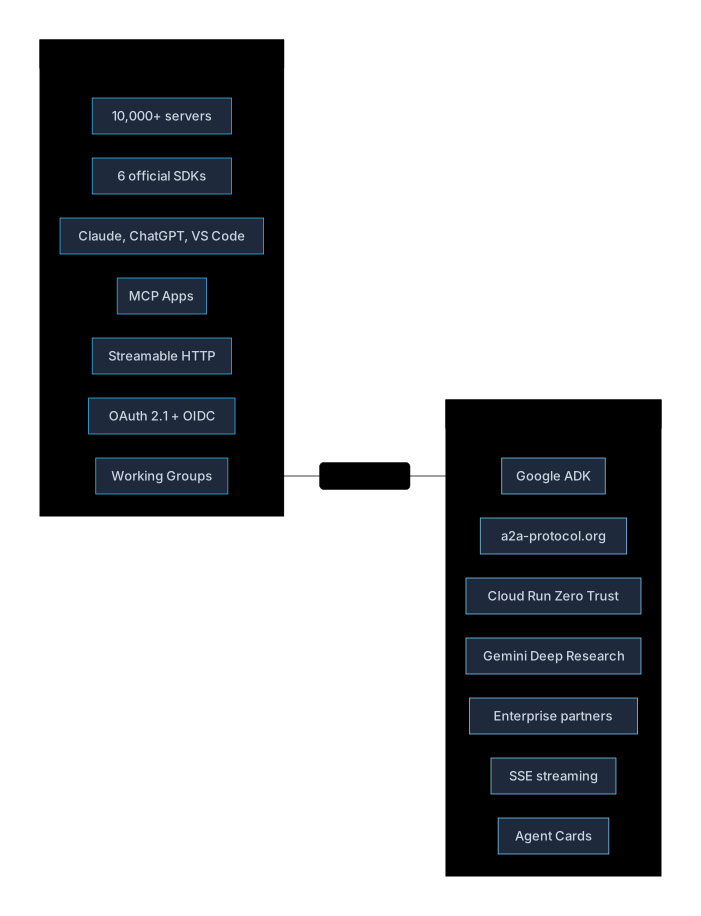
Both protocols have achieved significant adoption, though through different paths. MCP has seen broader grassroots adoption through the developer tools ecosystem, while A2A is gaining traction through enterprise and cloud platform integrations.
MCP Ecosystem Adoption
- AI Assistants: Claude Desktop, ChatGPT, Goose
- Code Editors: VS Code, Cursor, Windsurf
- Server Registries: Over 10,000 MCP servers published across multiple registries
- MCP Apps Adopters: Postman, Shopify, Hugging Face, ElevenLabs
- Enterprise: Companies building internal MCP servers for proprietary tools and data
- Governance: Formalized Working Groups and Interest Groups guiding specification evolution
A2A Ecosystem Adoption
- Google ADK: Primary implementation framework with Python and Go support
- Cloud Deployments: Zero Trust A2A patterns on Google Cloud Run
- Gemini Integration: Interactions API connecting A2A to Gemini Deep Research Agent
- Enterprise Partners: Atlassian, Salesforce, SAP, ServiceNow, and others building A2A-compatible agents
- Open Standard: Published at a2a-protocol.org with community governance
Ecosystem Comparison
10. What's Next: The 2026 Outlook
Both protocols continue to evolve rapidly. Here are the key trends and developments to watch in 2026:
MCP Roadmap
- Tasks Going Stable: The experimental Tasks feature (durable requests with polling) is expected to move from experimental to stable, enabling production use of long-running MCP operations.
- MCP Apps Maturation: Richer UI capabilities, more standardized component libraries, and deeper host integration for interactive experiences.
- Remote-First Architecture: Continued shift from local stdio servers to remote Streamable HTTP servers, enabling cloud-hosted MCP infrastructure.
- Registry Standards: Formalization of MCP server discovery and registry protocols for finding and connecting to servers programmatically.
- Multimodal Resources: Better support for image, audio, and video data as MCP Resources alongside text and structured data.
A2A Roadmap
- Broader SDK Support: A2A SDKs expanding beyond Python and Go to TypeScript, Java, and other languages.
- Multi-Cloud Patterns: Zero Trust A2A deployment patterns for AWS, Azure, and other cloud providers beyond Google Cloud.
- Agent Marketplaces: Platforms for discovering and connecting to specialized A2A agents, similar to MCP server registries.
- Complex Orchestration: More sophisticated multi-agent workflows with parallel execution, conditional delegation, and error recovery.
- Cross-Protocol Bridges: Standardized ways to connect MCP-based and A2A-based systems, potentially through gateway agents.
Industry-Wide Trends
- Protocol Convergence: While MCP and A2A serve different purposes, expect increasing alignment on shared concepts like authentication, streaming, and capability discovery.
- Enterprise Adoption: Large organizations moving from proof-of-concept to production deployments of both protocols.
- Security Standards: Industry-wide security frameworks for agentic systems, covering both tool access (MCP) and agent collaboration (A2A).
- Governance and Compliance: Audit trails, access controls, and compliance frameworks for multi-agent systems operating in regulated industries.
11. Conclusion
The AI agent protocol landscape has matured dramatically since we first wrote this guide. MCP and A2A have moved from emerging specifications to production infrastructure powering real applications at scale. The key insight that emerged in 2025 — and remains true in 2026 — is that these protocols are not competitors. They operate at different layers of the stack and are most powerful when used together.
MCP gives your AI application a standardized way to reach out to the world of tools and data. A2A gives your AI agent a standardized way to collaborate with other agents. Together, they enable the kind of sophisticated, multi-agent systems that are transforming how enterprises operate.
Key Takeaways
- MCP is the tool integration layer: Over 10,000 servers, six official SDKs, Streamable HTTP transport, OAuth authentication, and now interactive UIs via MCP Apps.
- A2A is the agent collaboration layer: Agent Cards for discovery, structured task lifecycle, streaming updates, and deep integration with Google ADK.
- They are complementary: MCP handles vertical integration (model to tools), A2A handles horizontal collaboration (agent to agent).
- The ecosystem is thriving: Major platforms (Claude, ChatGPT, VS Code, Google ADK) support one or both protocols.
- MCP Apps changed the game: Interactive UIs within AI assistants opened up entirely new categories of MCP server applications.
- Production-ready today: Both protocols have stable specifications, mature SDKs, and real-world deployments at scale.
Getting Started
For developers looking to build with these protocols today:
- Start with MCP:
- Read the specification at modelcontextprotocol.io
- Build a simple MCP server using the TypeScript or Python SDK
- Test it with Claude Desktop, VS Code, or another MCP-compatible host
- Explore MCP Apps if your use case benefits from interactive UIs
- Explore A2A:
- Visit the protocol website at a2a-protocol.org
- Try the Google ADK quickstart guides for exposing and consuming A2A agents
- Deploy a Zero Trust A2A agent on Cloud Run
- Connect your A2A agent to the Gemini ecosystem via the Interactions API
- Combine Both:
- Design your agent to use MCP for tool and data access internally
- Expose your agent's capabilities via A2A for collaboration with other agents
- Google ADK natively supports both protocols in the same agent
The future of AI is not a single omniscient model — it is an ecosystem of specialized agents, each with access to the right tools via MCP, collaborating through A2A to accomplish what no single agent could do alone. The protocols are ready. The ecosystem is growing. The time to build is now.